
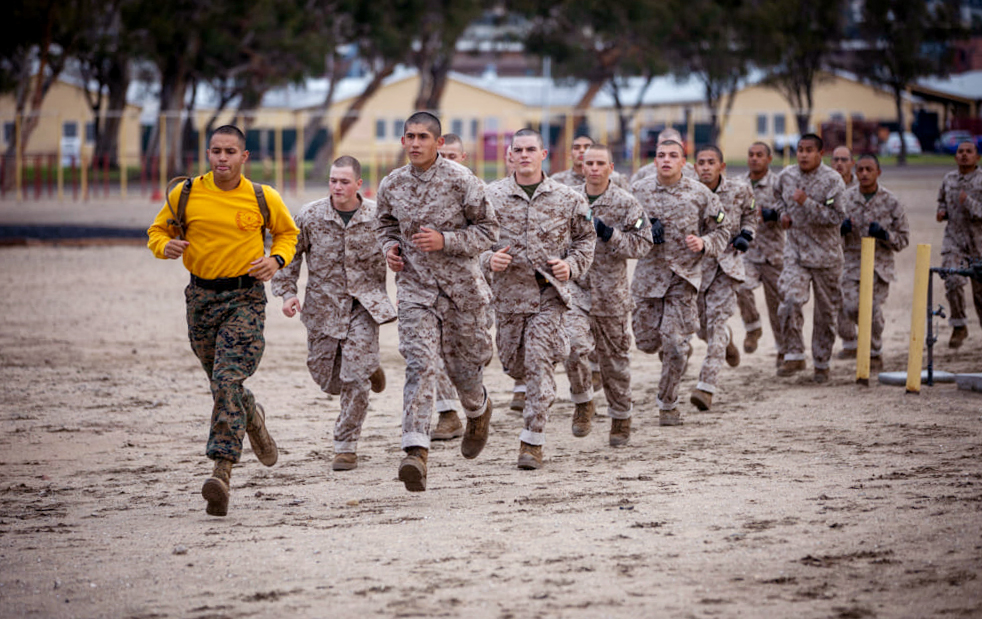
It has always been a challenge to use real time sport performance metrics in mental performance research due to the difficulty of measuring elite athletes during competition. The following study funded by the Office of Navy Research and conducted by the Naval Health Research Center attempts to do just that using soldiers during live training. Jensen, Bernards, Jameson, Johnson, and Kelly (2020) recruited 203 marines enrolled in the USMC Basic Reconnaissance Course. These soldiers averaged 22.7 years of age.
The participants were split into two experimental and one control group (Training As Usual; TAU). The experimental groups were to partake in either a General Mental Skills Training (GMST) or Mindfulness-Based Mind Fitness Training (MMFT). These athletes worked through the psychological interventions (or control condition) during the 3 phases of the Marine BRC. Each phase included real world physical skills such as high intensity water exercises, distance swims, water survival training, boat operations, and extended patrols.
The General Mental Skills Training included goal setting and commitment, arousal control, imagery, positive self-talk, and focus and concentration. The soldiers were trained on the ability to set long and short-term goals that are intended to result in greater focus, commitment, and motivation through planning as well as the ability to recognize stress symptoms and employ techniques (e.g., breath control) to reduce maladaptive reactions to stress. The GMST also taught soldiers to use of mental imagery to visualize carrying out a particular task to realize some desired outcome and the ability to generate an “inner monologue” containing constructive and positive characterizations of a given situation with the goal of regulating negative thoughts, feelings, and behavior during difficult times. Finally, the GMST trained individuals on the ability to resist distractions that often arise during task performance through the use of task-specific cues.
Measures of operational performance were collected over the course of the three phases. These operational measures were specific to the Basic Reconnaissance Course and included things like hiking, patrolling, communications, and a physical assessment test. In addition, cognitive measures were created to assess the soldiers mental abilities during BRC. A sustained attention response task (SART), as well as memory, facial recognition, mental accuracy tests were used to assess the soldiers cognitive aptitude.
Jensen et al., (2020) reported several interesting findings indicating the positive outcomes of a Mental Skills Training program. The researchers found during Phase 2 of the Basic Reconnaissance Course the individuals participating in the general mental skills training significantly out performance individuals participating Mindfulness-Based Mind Fitness Training and the control group. In phase 3, the GMST group and MMFT both significantly outperformed the control group.
On the cognitive evaluations, the GMST experimental group had fewer total errors than the control group, indicating they were more focused on the task at hand and exhibited more executive control. The GMST group also outperformed the control group on coordinate recall during the highly stressful ambush period, showing their enhanced ability to perform under pressure. Results from the plot time planned contrasts showed significantly faster times for GMST and MMFT when compared to the control.
Jensen et al., (2020) conclude “[Mental Skills Training] attenuates the physiological stress response and, in some instances, improves physical performance”. It is also believed that incorporating mental skills training into stressful training programs like the BRC may lead to improvements in cognitive performance. The researchers state “GMST is trending to be more beneficial than MMFT in operational and cognitive tasks”. This may be attributed to the difficulty in conducting an effective mindfulness based training program. It can be concluded that Mental Skills Training is a non-invasive method of arousal control, attention enhancement, and potential behavior modification.
Citation: Jensen AE, Bernards JR, Jameson JT, Johnson DC and Kelly KR (2020) The Benefit of Mental Skills Training on Performance and Stress Response in Military Personnel. Front. Psychol. 10:2964. doi: 10.3389/fpsyg.2019.02964
Leave a Reply